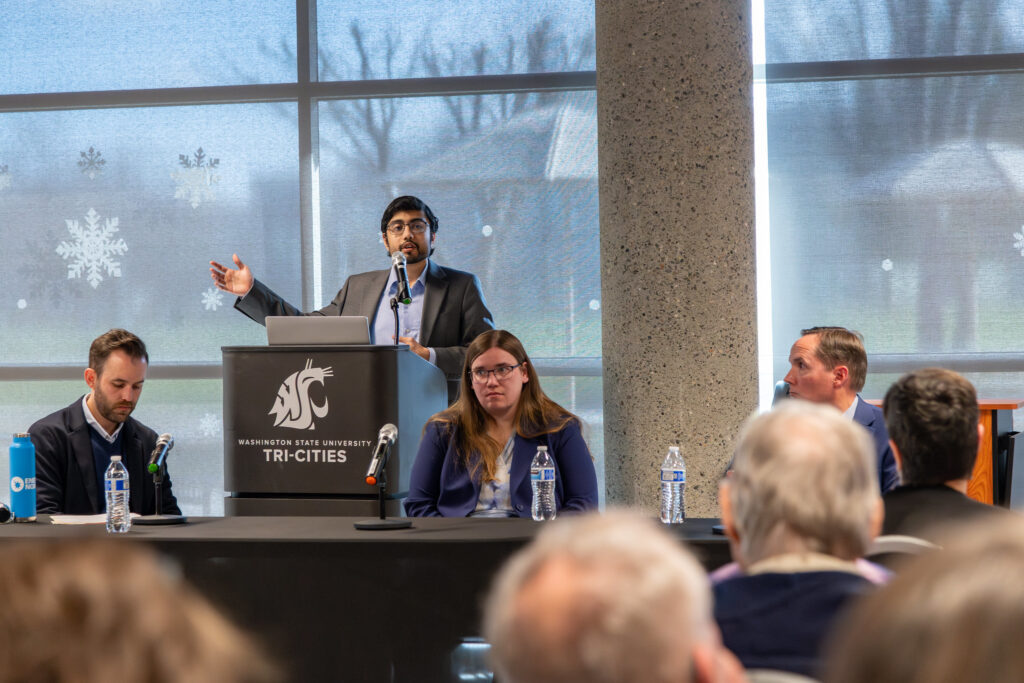
The demand for critical minerals is rapidly outpacing what current supply can meet, and traditional mining methods alone are unlikely to close the gap. Yet with improving technologies, advancing scientific knowledge, and growing public interest, there’s reason to be hopeful.
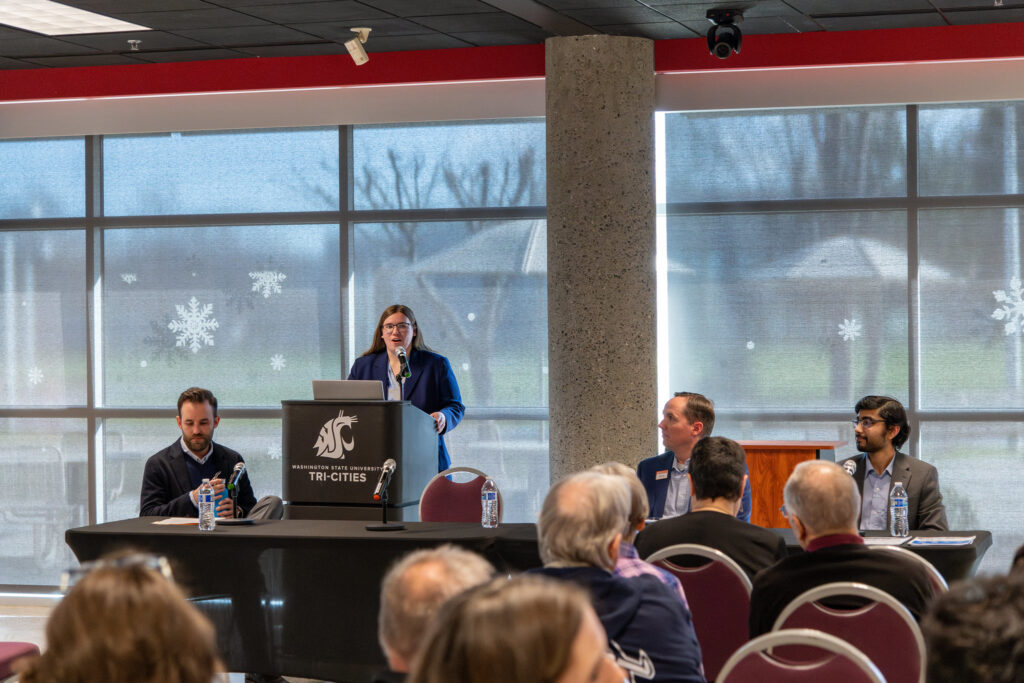
Those were among the main takeaways from last Tuesday’s INEF community forum, “Digging for Energy: Why Critical Minerals Matter,” attended by more than 100 people both online and in-person at the Washington State University Tri-Cities campus. The event convened four expert panelists, each of whom presented a different angle of the critical minerals debate before responding to questions from the audience. Sean V. O’Brien, executive director of the Energy Forward Alliance, served as moderator.
Erin Benson, assistant professor of critical minerals for the WSU School of the Environment and INEF faculty fellow, began with a short presentation covering the fundamentals of the topic, including what counts as a critical mineral and what does not. Ultimately, she said, a critical mineral is defined by two important factors — one being its vitalness to economic and national security, the other being its vulnerability to supply chain disruption.
In the United States, the most recently published critical minerals list includes 60 materials, most of which are elements, Benson said.
“We use the term critical minerals because it implies a resource that you’re mining from the ground,” she said. “But it’s not a very accurate term.”
Among those 60 items, she said, are the essential components that make up our smartphones, vehicles, electrical infrastructure, and more. And while most critical minerals are contained even in the rocks right under our feet, the resources required to extract such tiny amounts would render such efforts cost prohibitive — hence the importance of ore deposits, which contain high concentrations of specific minerals that can be mined and processed at a profit.
Since these deposits are a product of geological circumstances, however, their distribution around the world is uneven, meaning some countries have easier access to certain high-value mineral deposits than others.
The topic of China came up several times throughout the discussion as one example of a geopolitical competitor that currently supplies critical minerals to the United States. They also account for an estimated 70% of global mining and processing of rare earth elements, one important subset of the U.S. critical minerals list.
“If you can take one thing away from what I say today, mineral deposits are rare geologic phenomena,” said Sidney Smith, government affairs manager for the American Exploration & Mining Association, who presented next. “They really are hard to find.”
One benefit of domestic mining, Smith said, is that certain prized minerals are often — though not always — closely clustered with secondary minerals, some of which also appear on the critical minerals list. Gold mines, for example, often contain deposits of silver, copper, zinc, and antimony. Titanium exploration can likewise reveal associated rare earth mineral concentrations.
“This is important to understand because when you get your drill results as an exploration company, you’re going to have to look at that entire buffet of minerals that come out in those cores,” Smith said. “The economics really have to pencil out as you … make that decision to go forward.”
On the other hand, the regulatory processes for domestic mining are lengthy and costly, Smith said, as are the steps for surveying and finance. The exploration phase for a new mine can last up to 10 years or more, and the permitting phase can take even longer, as each targeted site will need to be studied for surface water, groundwater, and soil impact, as well as threats to endangered species and a host of other factors.
“The National Academy of Science notes that only one in a thousand exploration targets will ever actually turn into an operating mine,” Smith said.
He also noted that stringent regulatory standards are in place for a reason.
“The conditions in which these minerals are produced [outside the U.S.] are often appalling, frankly, in terms of environmental standards and human rights,” Smith said. “We are turning this around by reviving our domestic mining industry, which is the safest and most responsible mining industry in the world. … But that turnaround is going to take time, discipline, and a sustained focus.”
According to the opinion of panelist Nabajit Lahiri, research scientist at Pacific Northwest National Laboratory, limited timeframes mean we cannot rely on traditional mining practices alone. His presentation focused on emerging innovations with the potential to reduce the environmental footprint of mining and speed up regulatory processes by avoiding certain impacts altogether.
One such innovation Lahiri currently studies is in-situ mining — a practice that seeks to extract critical minerals buried deep underground by injecting fluids directly into the ore deposits. Those minerals are then pumped to the surface in a liquid-form solution that is ready for processing either on-site or at least domestically.
“What we do is very similar to what the oil and gas industry has done for decades. We will inject … a water-based fluid in the subsurface, and that fluid will then leach out the critical minerals,” Lahiri said. “The rock stays where it is.”
As a contrasting example to nontraditional mining, Lahiri showed an image from the open-pit Kennecott Copper Mine in Utah — an excavation site that has resulted in a kilometer-deep crater visible from space.
“What happens to this rock when you excavate it? You process it partly domestically and then … this is shipped over to China or some other country overseas,” Lahiri said. “That introduces a supply chain risk, because most of the chemical processing is likely done at those overseas sites. And then you have to import the copper back from those countries.”
Lahiri also spoke briefly on a few other developing technologies, such as bioleaching, which uses acid-secreting microorganisms to extract critical minerals from rocks, as well as phytomining, which utilizes rapid-growing plants known to absorb critical minerals from soil and rock substrate.
“What I’m trying to say is we need to be more open,” Lahiri said. “We need to research. We need to deploy these nontraditional mining tools.”
Aaron Feaver, WSU’s executive director for the Joint Center for Deployment and Research in Earth Abundant Materials, concluded the presentation segment by calling attention to the many ways his statewide organization has been working to advance ideas and solutions to the critical minerals challenge.
“Recognizing some of the workforce development challenges and the fact that a lot of folks are really not aware of these critical minerals, we’ve started on curriculum development program for K-12 students,” Feaver said.
The forum concluded with panelists addressing questions from the audience on related topics like waste recycling, geopolitical threats, and career opportunities in the critical minerals field. Smith was quick to respond to the latter question with an emphatic assurance that new talent is greatly needed, and all academic disciplines are welcome.
“More than half of the mining workforce is eligible to retire by 2029, so we are in a crunch for mining engineers, geologists, and metallurgists,” Smith said. “But we also really need people who wouldn’t think of themselves as miners or [being] interested in mining. If you think of yourself as an environmentalist and wanting to protect the environment, we need you too.”
You can watch the full event recording on YouTube. This was the second INEF community forum. The first event, hosted in 2025, convened around the topic of small modular reactors.
We look forward to hosting more forums on pressing energy topics soon.
—
For more perspective on the critical minerals topic, be sure to check out the following write-ups in the (1) Captial Press and (2) Tri-City Herald:
1. Critical minerals get spotlight during WSU community panel
2. ‘Critical minerals’ will shape NW future