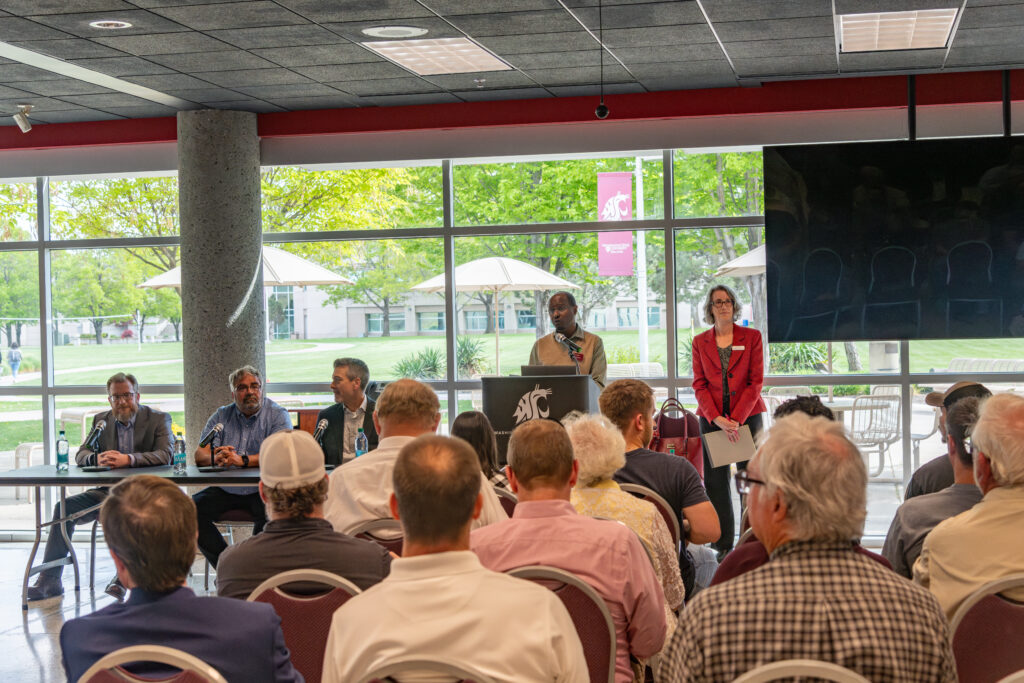
The Washington State University (WSU) Tri-Cities Institute for Northwest Energy Futures (INEF) hosted a panel forum April 22 to discuss Small Modular Reactors (SMRs) in the Tri-Cities region, and beyond, covering topics of sustainable energy, public perception, and the history of their creation and development.
More than 160 attendees joined the discussion either in-person or via Zoom. The audience was a mix of WSU staff, students and industry professionals.
“One of INEF’s core missions is to facilitate dialogue and advance research that supports resilience, affordable and low carbon energy future for the pacific northwest and beyond,” INEF Assistant Director Yonas Demissie said, “So today’s event reflects that mission, bring together experts from academia, industry, and national lab to engage openly on the topics that has both significant potential as well as pressing community questions.”
The panel was moderated by Tri Cities Area Journal of Business Executive Editor Kristina Lord and the panelists were Mark Nutt, manager, nuclear energy market sector from Pacific Northwest National Laboratory; Greg Cullen, vice president for energy services and development from Energy Northwest, and Corey Hines,director, Nuclear Science Center and NUCS Core Facility at WSU Pullman.
The panel began with a presentation by Nutt with some input from Cullen on the different sizes and evolution of nuclear reactors starting with the early Gen I reactors to the Gen II and Gen III Light Water Reactors (LWRs). The newer GEN IV revolutionary reactors contain innovative coolant technologies, such as gas-cooled reactors and sodium-cooled reactors.
The next topic of conversation was a broad overview from Nutt on what an advanced nuclear reactor is. Scaling from microreactors to small modular reactors, and large reactors, they generate from 1 megawatt (MW) to over 1,000 MWs.
“When you hear SMR, understand it’s one category of the advanced reactors that are being considered for deployment across the country,” Nutt said.
Lord asked the panel about some of the significant opportunities and challenges in deploying SMRs whether that may be in public perception, technological development, or otherwise.
On the topic of public perception of nuclear safety, Cullen said that through surveys done of Washington residents, the east side of the state has historically been more approving of nuclear energy than the west side of the state, but those numbers have levelized over the years.
“The idea again of the challenge we have in front of us to decarbonize our electric system, and the challenge of what that means for our climate change and those sorts of things had really changed the conversation,” Cullen said, “It’s changed people’s perceptions about nuclear, what role it can or should play.”
Cullen shared that Amazon has a large number of data centers in North Central Oregon, and the company has announced plans to build more which could be a good economic opportunity for Tri-Cities.
“Companies like Amazon in our case have recognized that they’re going to need a lot of power and they want it to be carbon free, and they need to be operating 24/7, and not just subject to the weather,” Cullen said, “So they have recognized the importance of nuclear in filling that role and the opportunity we have then is really huge for both this community and for this region because Amazon also has, in essence, shared a vision with us about allowing utilities to have access to this once they sort of help it get moving, get past some of the early risks and higher costs for these first ones.”
Hines brought up the issue of workforce development, saying that more people who are nuclear qualified are needed to work in the industry, and WSU is helping with that effort.
“Like I said earlier, we know that we need more nuclear qualified workers… and so what we’ve been pushing at WSU Tri-Cities is engaging those people earlier in their careers. At WSU in Pullman, we have a TRIGA reactor which has a lot of those inherent safety features that you’re talking about with SMRs.” Hines said.
During the Q&A session, questions were asked about how the nuclear industry deals with “black eyes” when a nuclear project goes wrong such as a recent project in Georgia.
Cullen replied to the question by saying “We learned a long time ago that if something happens to one of us, it happens to all of us, and so there are industry-wide efforts right now to gather all those lessons learned and put together guidance on how to do better.”
After the Q&A portion ended, Lord asked the panelists where the audience could find more resources on SMR technology, Cullen suggested the Energy Northwest website, and Nutt recommended the Idaho National Laboratory website.
More information about the INEF and the full panel recording is available on the website.