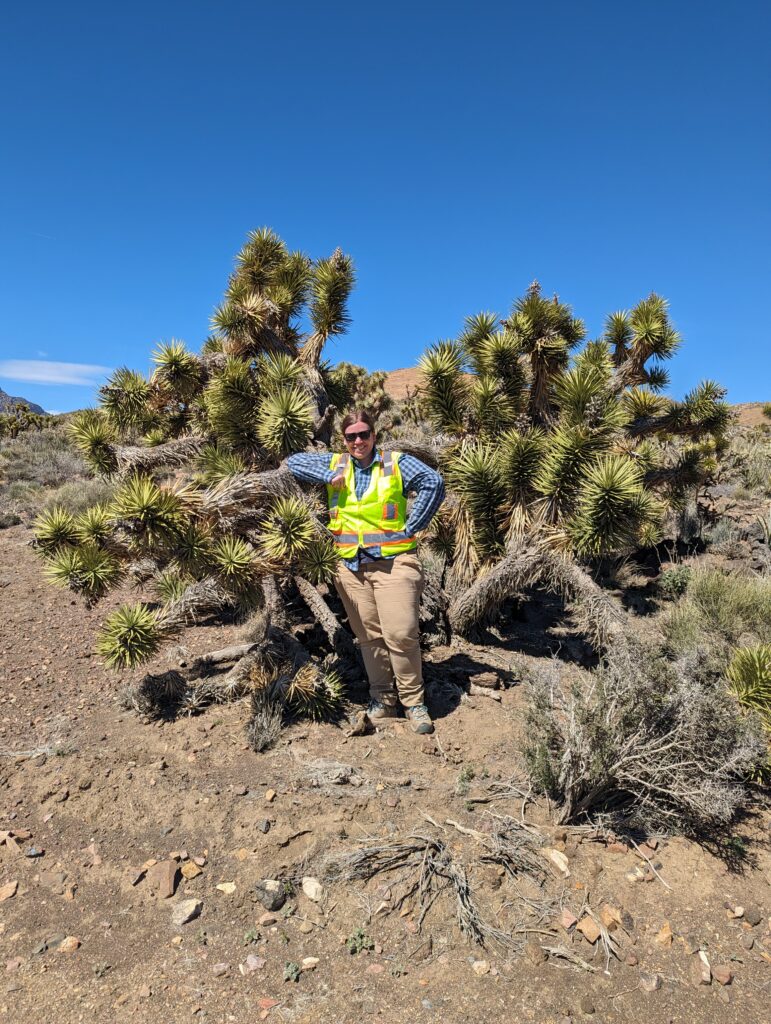
Erin Benson is an assistant professor in WSU’s School of the Environment and an INEF faculty fellow specializing in critical minerals.
She earned a B.S. in geology and a B.A. in archaeology at Western Washington University, an M.S. at Indiana University Bloomington, and a PhD at Duke University. She grew up in Spokane, Washington, where she spent a lot of time outside with her family and became interested in rocks.
“I’m interested very broadly in how ore deposits form in systems that are hosted by igneous rocks, because magmatic systems are really fascinating. It’s this whole cycle from the interior of the Earth that we never see, bringing up and concentrating the enrichments of critical minerals that we need for the functioning of society,” Benson said.
During her undergraduate studies at Western Washington University, Benson became involved in the research component of geology, which opened the door for attending graduate school.
“My undergrad research project was very focused on understanding how igneous rocks form And that becomes very applied when you’re thinking about, ‘How did this igneous body form in the context of the ore deposit that it hosts?’” Benson said.
Within INEF, Benson focuses on critical minerals, which are defined by two important factors. Firstly, she says, a critical mineral is an element or mineral that’s crucial to economic or national security. The second factor that defines a critical mineral is its vulnerability to supply chain disruption. “If your supply chain has a single point of failure — for instance, you import 100% of your material, but you ship it off to be processed and brought back in the supply — that supply chain is reliant on your relationship with your trading partners,” Benson explained.
Benson was drawn to Washington State University for multiple reasons, including her family ties to eastern Washington, and the opportunity to join INEF and the WSU School of the Environment (SOE).
“It was basically a perfect position for me,” Benson said. “INEF and SOE provide a lot of interdisciplinary collaborative opportunities that aren’t there in a more traditional geology department.”
Understanding the geology of critical mineral deposits, including how they’re formed and where to find them, is crucial when it comes to the energy space, as most everything required to facilitate the storage, transfer, or generation of energy and electricity depends on the materials found within them.
“Critical minerals are fundamental to all of our energy technology. You think about lithium-ion batteries, you think about copper wiring to carry electricity, you think of how rare earth elements are used in making magnets for wind turbines or electric vehicles,” Benson said.
Benson explained that even traditionally abundant elements like copper, which are necessary for carrying electricity through homes and buildings, have become or are becoming more scarce. In the case of copper, with demand forecasted to increase and most of the easy-to-find deposits already being mined, it will take time for new mines to come online and begin producing.
Benson recently organized a community panel for INEF about critical minerals and their importance, along with challenges we are facing to obtain them. More information on the panel can be found here.
“I think INEF provides a great opportunity for cross-disciplinary pollination that is otherwise very hard to achieve. That’s something I’m looking forward to as we bring more faculty fellows into the group and look for those opportunities to work to expand our energy potential in the Northwest,” Benson said.
Being a Washington-based geologist has other perks as well, Benson said, pointing to the rock and mineral formations more easily seen.
“Anybody who has driven across the state knows it’s like driving over all this basalt. We’re very fortunate to have that — it’s an incredible geologic feature. People fly to Ireland to see the Giant’s Causeway,” Benson said. “It’s just columnar basalt, which is in our own backyard.”