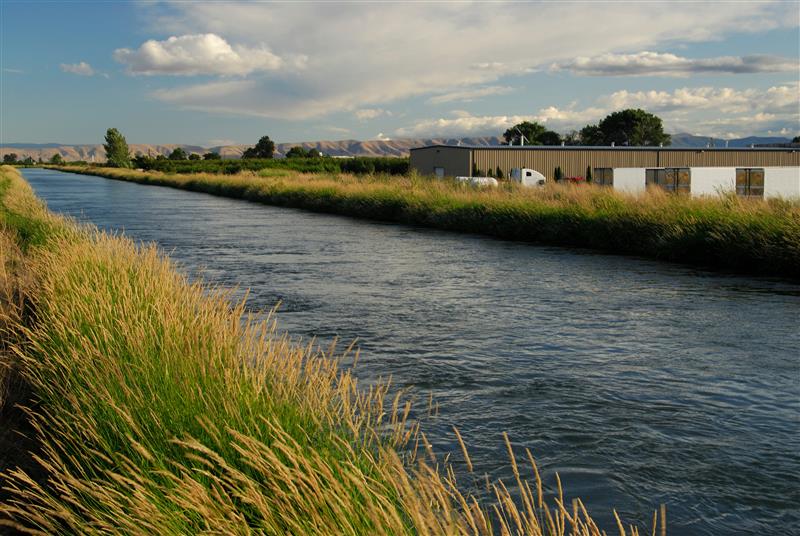
A new scientific study led by Washington State University Tri-Cities Institute for Northwest Energy Futures will examine the potential effects and benefits of combining irrigation canals with solar electricity generation.
With funding from the Washington State Department of Commerce, the project will gather and analyze existing data from the Kennewick Irrigation District to make informed predictions about how the installation of photovoltaic panels over canals could impact water quality while also providing off-grid power to irrigation pumps.
 Yonas Demissie, associate director of engineering and environment for INEF, is serving as the principal investigator on the project. If the results of the study show promise, he says, future grant funding could facilitate the construction of a prototype solar panel installation for further research.
“This aligns with our broader efforts to understand the interrelation between energy and water,” Demissie says. “Especially in our area, they are highly interrelated.”
Similar to the INEF-led agrivoltaics research project installed at Sunrise Orchard near Wenatchee, Wash., Demissie says this research explores another method by which to expand energy production in a way that complements agricultural land use.
Ideally, he says, solar panels could provide other benefits beyond electricity. By providing shade during warm-temperature periods, solar panels might reduce water temperatures and evaporation. Lower water temperatures could, in turn, help to mitigate algal bloom, which depletes oxygen for fish and creates toxicity.
“If you have an aquarium, you know how problematic algae can be to the water quality and the fish,” Demissie says.
While this study will be among the first of its kind in the region, Demissie notes there are similar solar-panel-over-irrigation research projects underway in California and Arizona, as well as many other “aquavoltaics” studies involving solar panels being used as a shade covering for bodies of water. The WSU project will draw lessons from these efforts.
Longterm, Demissie says, the lessons of aquavoltaics research could potentially be applied to regional water and energy infrastructure planning to enhance climate resilience by conserving and cooling water while providing distributed renewable energy.
The Kennewick Irrigation District is one of seven major districts that divert water from the Yakima River for agricultural use. The Yakima River also produces an estimated 107,000 megawatt hours of electricity from two hydroelectric dams, and some additional power is generated from smaller irrigation dams.
Demissie says this new planning project fits within INEF’s research focus on the food-energy-water nexus, which seeks to better understand the interrelated systems and dynamics affecting food, energy, and water resources.
“This is not a static system,” Demissie says. “If one of them fails, the rest will not sustain.”