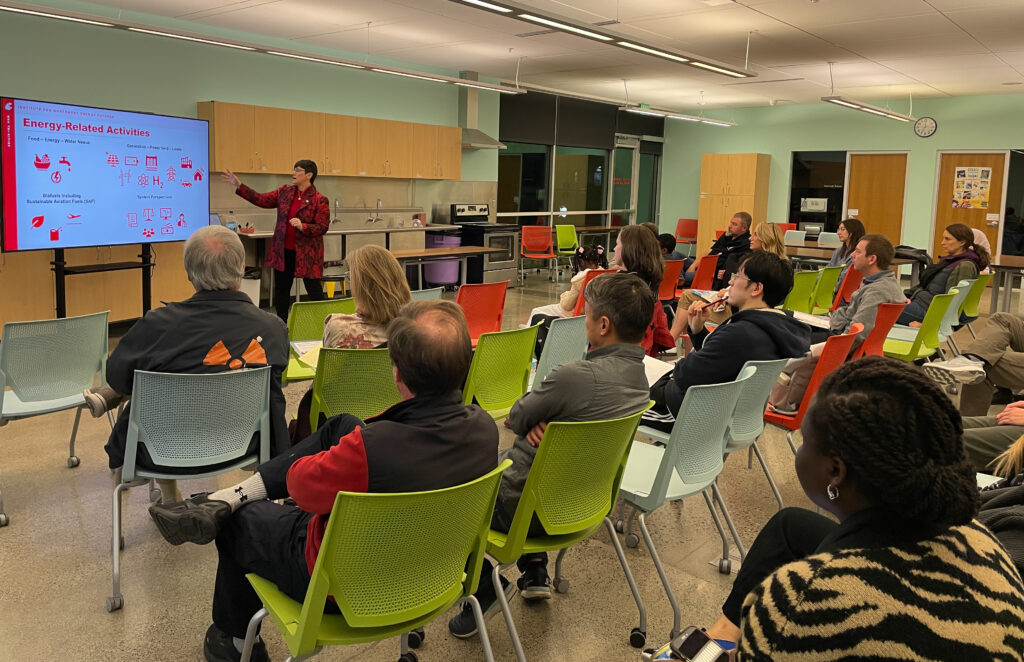
Washington State University Tri-Cities and its Institute for Northwest Energy Futures (INEF) are not just engaging academics and industries in the possibility of a carbon-neutral future—they’re inviting the community to be part of the journey. On Nov. 6, INEF leaders, faculty, staff, and students from WSU Tri-Cities connected with local residents at the Richland Public Library to share insights and initiatives aimed at addressing clean energy challenges.
The event drew a diverse audience, including community leaders like Rep. Stephanie Barnard, students, educators, and residents passionate about clean energy.
Noel Schulz, INEF’s Inaugural Director and Bob Ferguson Endowed Professor shared the institute’s vision and outlined its systems’ approach to clean energy.
“INEF is bringing together professionals from across the WSU system to collaborate and find industry and research partnerships,” she explained. “Experts are working to tackle clean energy challenges, from developing new technologies to increasing building efficiency and optimizing operations with AI. Combining these efforts can make the sum greater than the parts.”
Chad Kruger and Yonas Demissie, assistant directors at INEF, shared their expertise on agriculture electrification and water use considerations—two critical areas for the region’s future.
Kruger introduced innovative ideas such as agrivoltaics, a practice that combines solar energy production with agricultural activities. “These solutions can support local fruit farmers while contributing to the clean energy transition,” he said.
Demissie highlighted the importance of water management in energy systems, noting that sustainability efforts must consider water usage as an integral part of the equation.
Workforce development was also highlighted as a key factor in the transition to clean energy. According to the U.S. Department of Energy’s 2024 U.S. Energy and Employment Report, clean energy was the driving factor for growth in the energy sector. In 2023, jobs in clean energy grew by 4.2%, more than twice as much as the job growth rate of 2.0% in the overall economy.
Two key programs at WSU Tri-Cities are central to these efforts:
- The Clean Energy Ambassador Network connects students with industry experts and helps them develop projects focused on clean energy. “These students are our future leaders,” declared Jillian Cadwell, WSU Tri-Cities research associate and leader of the Clean Energy Ambassadors Network (CEAN). “Through mentorship and hands-on experience, we’re equipping them with the tools they need to drive innovation in the energy sector.”
- The WSU Tri-Cities Cougar Tracks program offers customized, on-demand training to assist with workforce upskilling and reskilling. “Transitioning to clean energy isn’t just about new technology,” said Michelle Hrycauk Nassif, director of Cougar Tracks. “It’s about ensuring that our workforce is prepared to implement and maintain these innovations.”
INEF’s posters, including several showcasing CEAN student projects, were displayed in the library’s foyer, offering visitors a closer look at WSU Tri-Cities’ work. After the presentation, students engaged with attendees, explaining their projects and discussing their ideas for the future. Clean energy projects included ideas as diverse as imagining a microgrid, recycling an internal combustion engine, home improvements, and career awareness.
The INEF posters will remain on display in the Richland Public Library entryway through Nov. 30.