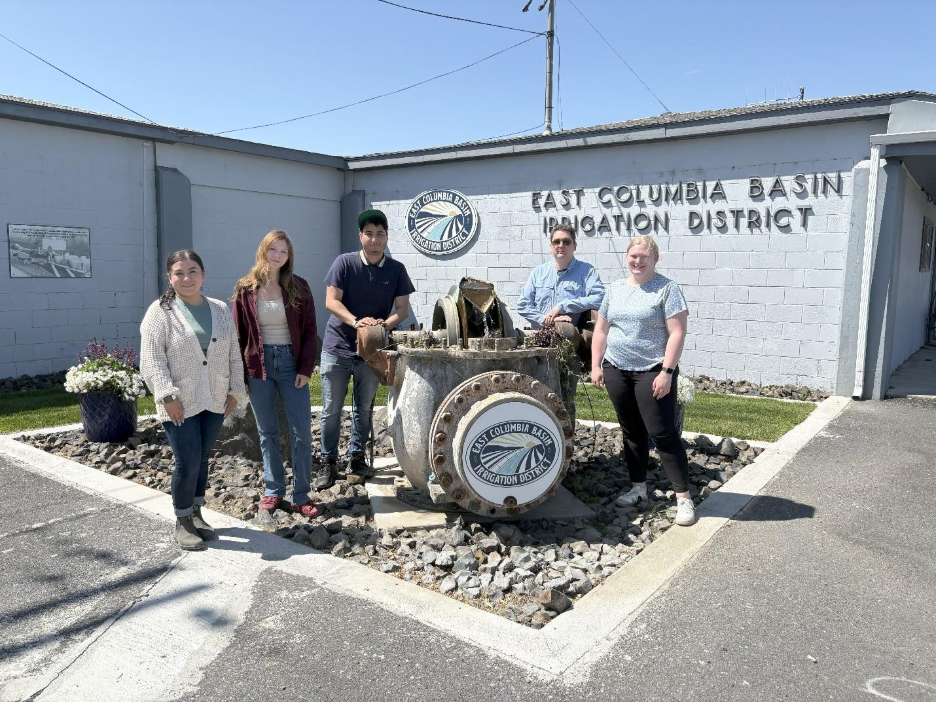
On June 21, student interns from the Washington State University (WSU) Tri-Cities Institute for Northwest Energy Futures (INEF) visited the East Columbia Basin Irrigation District to tour the Odessa Groundwater Replacement Program (OGWRP) sites to learn more about the work being done on-site and how it can apply to their research interests.
The purpose of OGWRP is to provide and transport water from the Columbia Basin to additional farmland in the area, spanning 65,000+ acres.
The students were given the opportunity to ask questions of the staff working on the Odessa project. One of the questions asked was “If you could go back in time, what would you do differently?”
“Craig Simpson from [East Columbia Basin Irrigation District] ECBID said they would have preferred the project (canals, pumps, pipes) to all be completed decades ago at the original time of approval rather than be delayed,” INEF student intern Evalena Dalsbo said.
The delay was due to the high costs of completing the project, so farmers continued to relying on groundwater, a resource which has been declining in the region where the Odessa project is underway, according to the OGWRP website.
The student interns represent a variety of engineering and scientific disciplines, and because of the size of the Odessa project there were many facets of engineering and different factors for the students to find compelling, no matter what their niche within the field is.
“I would say as an engineer, I was more interested in how they [were] planning everything out, how they’re developing this plan to make everything and even some of their technologies was pretty interesting. Since I’m mechanical [engineering], I liked to look at their pump house, and all the different stuff in there. That was super interesting to me,” student intern Quinn Norton said.
The INEF students focusing on civil engineering had their own unique highlights.
“I kind of liked how it was like a partnership between multiple disciplines and multiple groups and partners, and I thought that was interesting. How they each kind of had to collaborate with each other to get things done,” student intern Aliyana Avalos said, “OGWRP is essential in maintaining local economies by supplying surface water for irrigation to farmers and landowners. This program is the only way Odessa and nearby regions could ever receive enough water to irrigate existing croplands in the near future.”
As one of the biggest national reclamation projects, and one of the biggest suppliers of irrigated water in Washington State (Columbia Basin | Washington State Department of Agriculture), an important facet of the Odessa project is the process of getting the water from the Columbia River to where the farms need it to go.
“I was really interested about how they get canal water all the way out to the farms through the irrigation system. It was super cool to learn about,” student intern Roy Leal said.
Talking to federal, district, and conservation professionals and visiting irrigation sites gave the students a great way to see academic concepts applied in real life situations, and the Odessa site visit was a great example of that.
“Visiting Odessa was a great opportunity to see firsthand how the project we’ve been reading about actually works. It was such a valuable experience to meet the various organizations involved and gain a deeper appreciation for all the hard work and collaboration that has gone into making this project a reality,” student intern Zoe Pfeifer said.
Jillian Cadwell, INEF assistant director forprogram development and student engagement, works with and oversees the student interns and praised their ability to get the field trip organized.
“The students earned a “gold star” for planning this trip. They really did a good job of being prepared and getting the stakeholders together with plenty of lead time,” Cadwell said.