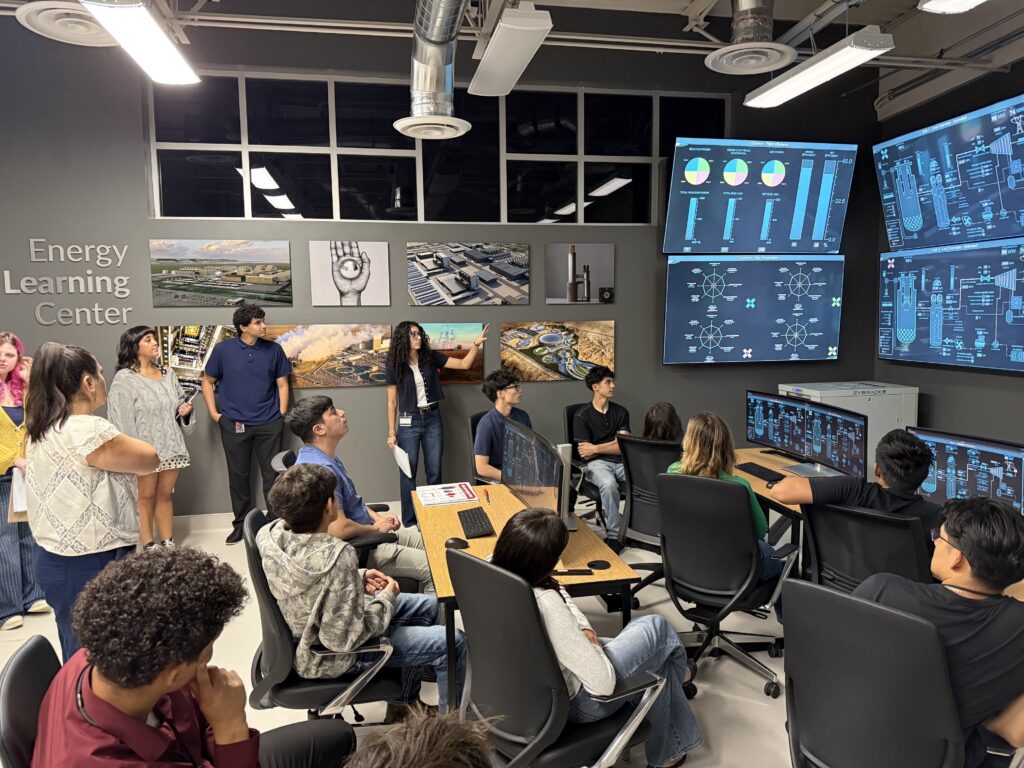
Fourteen high school and college students got a firsthand glimpse into the future of nuclear energy during a July 20 visit to the Washington State University Tri-Cities’ Institute for Northwest Energy Futures. The visit, part of a six-week “Energy and the Grid” Pathway Summer Schools program at Pacific Northwest National Laboratory, was designed to introduce students to the growing role advanced nuclear technologies are expected to play in meeting future energy demands.
Through a series of presentations led by eight INEF and WSU Energy Program student interns, Pathway participants learned about the design of small modular reactors (SMRs), as well as the upcoming Cascade Advanced Energy Facility north of Richland. The WSU student interns also led the Pathway students through a hands-on demonstration of the Xe-100 SMR control room simulator in the Energy Learning Center.
For Energy Program intern Anas Mohamed, now entering his junior year as a WSU Tri-Cities mechanical engineering major, the July event was a welcome opportunity to share insights from his past several months of research into SMR technology. As a previous INEF intern for fall 2025 and spring 2026, he worked closely with industry mentor Chris Maxwell, operational readiness manager at Energy Northwest, on learning about the inner workings of SMRs, including through the use and operation of the Energy Learning Center simulator.
“He’s the main person that helped us with the simulator room,” Mohamed said. “It’s been a great resource for our projects and our research.”
The Energy Learning Center is operated in partnership with Energy Northwest and Columbia Basin College. Since its official opening last February, the center has hosted hundreds of visiting guests from industry, academia, and community groups.
This wasn’t the first time Mohamed helped demonstrate the SMR simulator to students, having given similar presentations to visiting groups from Delta High School and Oregon State University. He said he was impressed with the Pathway students’ grasp of the subject matter.
“They had a really decent background about how nuclear reactors work and nuclear power in general, so that made it really easy,” he said. “Their questions were so effective and really on point.”
WSU Tri-Cities computer science major Evelyn Castro had the unique perspective of participating as both an INEF intern and Pathway Summer Schools student.
“I really enjoyed being both a student with PNNL and a presenter who had the opportunity to introduce myself as an INEF team member,” Castro said. “This experience helped me build my confidence, strengthen my public speaking skills, and better understand the importance of the work being done at INEF.”
Prior to their INEF site visit, Castro said her Pathway cohort had been learning about multiple energy sources — including hydropower, marine, and nuclear — as well as power grids and the challenges of growing energy demands. Students in the program also visited McNary Dam and various PNNL research facilities, such as the Grid Storage Launchpad.
“As we learn about each energy source, we get assigned a type of energy, and at the end of the week we present a short research poster discussing how our given source can help power the grid and how [artificial intelligence and machine learning] can be implemented to help this process,” Castro said. “We look at data requirements and the environmental impact.”
The other WSU student presenters included INEF interns Olivia Kanoff, Madison Manley, and Hayley Mendoza, as well as Energy Program interns Evalena Dalsbo, Mauro Martinez, and Timothy Poole. Jillian Cadwell, INEF research associate faculty, also presented and helped coordinate student engagement for the event. Additionally, INEF researcher Tejas Ghirnikar and INEF faculty fellow Guiyan Zang spoke to the students about their INEF-focused work.
Students were accompanied by program organizers Margarita Magaña and Elizabeth Stephens, both from PNNL. The Pathway program is offered through the U.S. Department of Energy’s Office of Workforce Development for Teachers and Scientists.