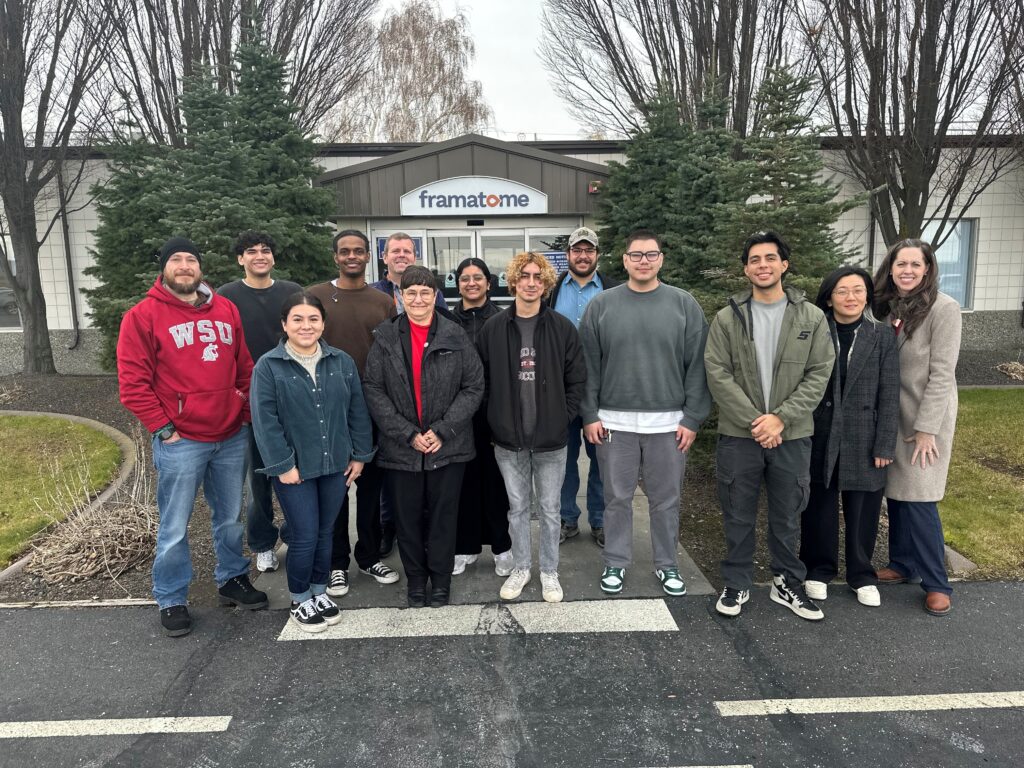
Student interns from the Institute for Northwest Energy Futures’ Energy Ambassadors Network (EAN) had the opportunity to go on two site visits during the spring 2026 semester, getting a behind-the-scenes look at different aspects of the Mid-Columbia energy sector. Their first visit was to the Framatome nuclear fuel manufacturing facility in Richland; the second was to the McNary Dam in Umatilla, Oregon
Framatome is an international company based in France that works on the design and manufacturing of nuclear reactors and their components. As part of their on-site tour to the company’s Richland location last February, students were able to get an up-close view of the manufacturing process of nuclear fuel assemblies that power commercial nuclear reactors. These processes included seeing how uranium dioxide pellets were made and inserted into fuel rods.
“We saw where the entire fuel rod manufacturing process takes place, from the intake bay where giant cylinders of uranium are delivered, down the multiple stages of processing at the assembly lines, to the packaging and send-off zone at the end,” student intern Evalena Dalsbo said. “It was interesting to learn about the client and manufacturer relationships as well, and the complexities of developing different fuel types for different reactors.”
WSU Tri-Cities Assistant Professor Sihui Li, who was also on the site visit, said it’s beneficial for students to learn about what local companies are doing and the skills they’re looking for while they are still in school.
“Many students from the Tri-Cities campus stay in the area after they graduate and join local companies. So it’s helpful if the students know what the companies need,” Li said.
Li said it was also valuable for faculty to see how their areas of academic research and expertise are being used and adopted out in the field. For her part, she was interested in seeing how robotics factor into the production of nuclear energy systems.
With the Tri-Cities being a nuclear energy hub, Framatome having a production center in the area makes sense, but it might not be something that many people know about. Even those who know of the company may not be familiar with the specific reactor components they work on locally.
“It wasn’t until we went inside that we were able to tell what type of work they do,” student intern Hasan Cruz said. “I had a misconception of what the labor was, and then I understood that it’s nuclear fuel. They are producers of fuel and they distribute it everywhere in the U.S.”
The second EAN site visit took place in April at McNary Dam, managed and operated by the U.S. Army Corps of Engineers. While there, INEF interns joined other WSU Tri-Cities engineering majors as they learned about hydropower and the engineering processes behind dams.
INEF Assistant Director of Engineering and Environment Yonas Demissie said the McNary Dam was purposely selected as a prime location where multiple fields and academic disciplines could be seen working together.
“We try to bring electrical, mechanical, civil, computer science, and INEF students,” Demissie said. “Dams have that multidisciplinary feature, so almost everybody has a certain aspect of the dam that is of interest to them.”
During the site visit, the students started at the bottom of the dam, where the generators are housed, and worked their way to the top of the structure. They were also able to see the turbines that generate electricity as the water flows through them.
“They have 14 turbines and each of them can produce from 60 up to 80 megawatts a day,” Demissie said.
Despite being one of the few non-engineering majors in attendance, Dalsbo had no trouble making connections to her area of study.
“I was the only environmental science major on the tour, and the head of operations of the dam talked to me personally for a little bit,” Dalsbo said. “He said they have an environmental science compliance expert on staff who is there to make sure that they’re following all the environmental laws and regulations and are doing the best that they can for the fish and any other organisms in the water.”
Being able to provide and facilitate these kinds of site visits for students is an important part of the INEF intern experience, Demissie said, as it shines light onto real-world situations and collaborative workforce environments that students might experience after they graduate.
“It gives students a chance to go outside of these textbook topics and have that feeling of getting to smell the water, hear the sound, touch the infrastructure,” Demissie said.
In addition to the two site visits this semester, INEF student interns previously visited the Odessa Groundwater Replacement Program, Pacific Northwest National Laboratory, and WSU Sunrise Research Orchard last fall.
“[Site visits] give you direct exposure to a field that you care about. This kind of opportunity helps bridge the gap between [being] a student and understanding what professional work in different sectors actually looks like,” Cruz said. “We’re not talking just about producing electricity or producing energy, but also about delivering it.”
Cruz said the visits also illustrated the importance of environmental responsibility, whether dealing with nuclear, hydropower, or other energy sources.
“It’s the beauty of that correlation of energy, water, natural life, and then the environment,” Cruz said. “You have to consider all of them and make them work all together.”